




The world as we know it is rapidly changing, driven by advances in technology that none of us imagined, let alone possessed, twenty years ago. The devices we currently use and take for granted were the stuff of dreams even a generation ago, yet it’s easy for us today to envision an even more “futuristic” near-future.
The foundation of that era, and the next major phase of mobile telecommunication, is fifth-generation (5G) technology, which will provide people access to extreme broadband speed, ultra-low latency, and ultra-reliable web connectivity. And it’s no secret that Verizon is leading the charge.
Our aim with the three films in this campaign is to highlight the possibilities inherent in 5G’s technology, and how it will improve the experience of consumers and businesses alike. These 2-to-3-minute films will demonstrate all the amazing things viewers can do when everything around them — digital devices, vehicles, sensors, roads, cameras — is connected to and communicating with each other. Our goal is to empower people and excite them about using this cutting-edge technology.
We will demonstrate how Verizon’s 5G Network operates differently from its competitors because — put simply — it was properly built. Because of that, this technology allows wonderful things to happen, creating a revolution in the way we interact with technology, which, in the end, improves lives.
So even though this is a campaign rooted in technology, it’s important that we ground it in humanity so viewers can recognize themselves and their lives in a technologically-advanced world of the very near future.
I’m excited about finding the right balance between the personal and the technological on this amazing project. It’s the kind of filmmaking I love to be a part of. As we collaborate on this project through a process of dialog and discovery, we will find ways to flesh these scripts out even further and make them the very best they can be. In the meantime, here are some initial thoughts and ideas I have on how I see these films playing out.


cast·ing | kastiNG |
noun
1. act of finding the perfect female spokesperson to play an interregnal role in three long-form Verizon films.
2. critical decision, especially in the success or failure of making these Verizon films great.
synonyms: pivotal, critical, key, climacteric, decisive, deciding; life-and-death “The director stressed that casting was key.”
While it’s true that casting is critical to any film, that’s especially true here because so much rests on the authenticity and relatability of the spokeswoman.
She’s intelligent and sophisticated, with an authentic smile, bright eyes, and an earnest desire to inform. She’s accessible and relatable, and reasonably cheerful. Her voice has a pleasing timbre that connects with and engages us. She gets the technology. She gets you.
We will cast as wide a net as possible in Vancouver and Toronto so we can find the right woman — the one with the charm and skill-set we’re looking for, most importantly the ability to deliver a credible performance while walking and talking to camera as she reads text off a teleprompter. This may sound simple, but it takes a certain talent to do this well.
As is usually the case in these situations, we’ll know her when we see her.
Aside from our spokeswoman, we will cast a real-looking and diverse set of principals who express authenticity, whose faces and body language trigger something truthful and honest in ourselves. From the customer in the retail store to the firefighter to the kids out in nature, we need to be able to connect with these people and their sincere performances so the technology we capture blends seamlessly with their humanity. That quality is crucial to the success of these films.
Chile is a great place to work. I’m familiar with its access to a wide spectrum of looks, and well-versed in its casting protocols. I’d be hard pressed to suggest a better country to represent the authentic range of looks, ages, and ethnicities we’re going for in our films.
HOW?
WHO?


In each film, life plays out naturally and at normal speed. Everything will look realistic and lifelike. Then, when we want to enhance Verizon’s 5G technology, we will slow the world down to a near-frozen moment. Our graphics will appear, moving and growing throughout each scene. Our audio will drop a few octaves. The natural sounds of the environment will be replaced by the subtle digital, near-future sounds the graphics make as they grow, shift, and move in this world.
The graphics we’re creating will act as characters in these films. The typography, iconography, and informational graphics represented in each film will be immersive and kinetic. They’ll build fluidly around our heroes and amongst their environment. They will borrow traits from the live action — catching shadows and light, tracking with characters’ movements, and reacting to the camera as if they were physical objects residing in the scene.


DEPTH
SOME WORDS FROM OUR POST HOUSE, BAKED STUDIOS
Since, we are playing in a world of the un-seen, we want to be very thoughtful in our approach on how to bring these elements to life.
Our intention lands right at the epicenter of impact and integration. The goal here is to relay the feeling of being blanketed by these beneficial signals and bits of information that create our interconnected world. Revealing the un-seen symphony that helps to facilitate our daily lives should feel eye-opening. We intend to make it very clear that 5G is the next step forward in the evolution of bringing us all together.
We avoid the look of overlays, completely. These elements need depth and dimension to blend into our world. Top of mind will always be seamless integration — meaning, sometimes our grapics land in the foreground, sometimes in the background. It’s that playing with perspective that helps make what we’re seeing believable.
CLEAR
click below to know more about
Baked Studios


SCRIPTS


OPENING SCENE: MAGIC MIRROR
This is a great film that has huge creative potential. Here, our spokeswoman takes us on a technological journey from a modern city street through a near-futuristic retail clothing store to an autonomous construction site, ending in a high-tech, visually-striking manufacturing plant. Our goal is to show viewers how Verizon’s super-powerful and super-fast 5G technology is helping businesses move faster than ever.
We open on a city sidewalk with our bright, confident, intelligent spokeswoman walking and talking to camera. The city behind her is modern and near-futuristic. As she walks toward camera, she delivers the first line:
“The faster your business moves, the more potential it has.”
To help draw emphasis to this next line, she stops close to camera.
“But your business can only move at the speed of today’s technology.”
We’ll also cover it without her stopping, so you have options in the edit.
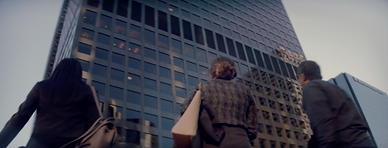
We pan over to pick up our HERO CUSTOMER walking down the sidewalk in front of the modern building. Wider framing reveals a near-future retail storefront window. Our customer walks by and looks into the window/mirror. Instead of seeing a mannequin wearing the latest fashions, he sees his own reflection, wearing a sharp new outfit.
Our graphic overlay appears all around him. These graphics allow the viewer to see the 5G technology at work. As this happens, our world slows down. On his reflection, we see the clothing digitally change in an interesting way. New graphics appear, highlighting new information about the new clothes he’s virtually trying on.
Intrigued by what he sees, he steps closer to the storefront window/mirror — closer to his reflection. We cut to a reverse angle on him from inside the storefront window, looking out, past the graphics. This angle allows us to see the humanity on his face, the spark in his eyes as we push-in on him — again — connecting the human element to the 5G technology. He’s pleased with what he sees. Over this scene, we hear our spokeswoman’s VO:
"That’s why at Verizon, we’re building a network beyond today’s imagination. It’s called the Verizon 5G Ultra-Wideband network. And we’re building it right — fulfilling 5G’s potential and creating all kinds of business possibilities. Consider the competitive world of retail. The lower latency and faster throughput of 5G could blur the line between the physical and digital, helping retailers compete with new and differentiated experiences in and out of store.”
Back to normal speed, back to realism. From our SALES ASSOCIATE’s POV, we see our customer walk through the front doors of this sleek and modern retail store. As this happens, our world slows down again. Our spokeswoman enters frame in our slo-mo moment. She says:
“Soon, interactive displays and virtual-assisted technologies will be able to connect the entire shopping experience."
We cut in closer to our sales associate, using her device. We cut to an over-the-shoulder shot on her device as it recognizes our customer. On the device’s screen, a slow-motion image of our customer’s profile appears, with our graphics all around him, giving our sales associate detailed information about him. We ramp back to normal speed as the sales associate greets our customer. In real-time, they have a friendly conversation.
Our spokeswoman continues:
"When cutting-edge AI is paired with 5G, retailers will be able to identify valued customers, understand purchase history and deliver experiences that anticipate customer needs in the moment.”
Technical Note: The plan for the storefront scene is to keep as much of this effect practical — meaning done in-camera. The only part of this scene we’re “faking” is his reflection, which will be shot on green-screen, and comped into the mirror later in post. The reflections of the city, and even the people walking by, will be done in-camera. This way, our reflections will look accurate and totally realistic. We will work diligently on set to mimic our customer’s precise movements so his reflective self is spot on. We will also have the ability to adjust his movements slightly in VFX. This is an exciting scene that has great potential!



SCENE 2: TRANSPORTATION USE CASE
Cut to the exterior of our retail store as our spokeswoman exits into the street. She walks and talks to camera:
“Possibilities will also skyrocket when it comes to the Internet of Things. With the power of 5G, IoT devices can scale to billions, scaling business potential right along with it.”
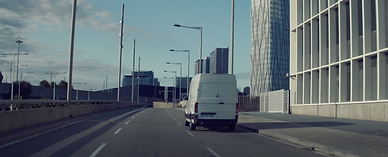
The camera pans into the street and settles on the busy traffic passing by. A delivery truck enters frame. As it does, the scene slows to a near-frozen moment. The city noise drowns out. Our graphics begin to extend out from the delivery truck — growing, expanding outward, connecting to sensors in the road, showing how the delivery truck stays connected, thanks to 5G. On the right side of frame, our spokeswoman enters in real-time:
“For example, a huge number of sensors in roads, railways and airfields can transform logistics — and nearly every industry as well.”
She exits frame left and continues walking.
Note: To incorporate our spokeswoman into our slow-motion scene with our graphics, we will shoot her on green-screen right there on the street and in the natural daylight. This way, the two images will merge seamlessly and look completely believable, as if she’s really standing there in this near-frozen world with our graphics spreading out in the background. Motion Control is very tedious and can take three times longer to set up. With our tight shooting schedule and budget, we feel this is the perfect way to integrate our spokeswoman into our slow-motion environment with our graphics. We will also shoot a few close-up plates in this scene so you have the ability in post to cut away from our spokeswoman. Again, my aim is to make sure you have the options you may want in post.



SCENE 3: CONSTRUCTION USE CASE
Instead of match-cutting to the Autonomous Construction Site, let’s create an intriguing, transitional wipe to get us seamlessly to our next scene. We do this by panning upward, into the sky. In post, we simply blend the two worlds together as day dissolves to night. The camera comes back down to reveal we are now at our Autonomous Construction Site. Interesting transitions like these will help keep our viewers interested and engaged.
Now we see, in real-time, two completely autonomous machines working, burning the midnight oil (or batteries in this case). The machines will be sleek and futuristic — something we haven’t quite seen before, not yet anyway. Our spokeswoman appears at the edge of frame. She talks to camera while the heavy autonomous machines continue to excavate.
“No one can work 24 hours a day, nor can companies waste resources. That’s where remotely operated and autonomous machines come in.”
Here, we slow down the world. The sound drops out and our graphic overlays appear, growing and expanding from our machinery. The graphics work to explain the low latency and throughput of the machines. We cut into tighter framing to focus on more detailed images of our graphics and the machines. We hear our spokeswoman’s VO:
“5G creates new potential for edge computing and AI to drive operations continuously, allowing businesses to get ever closer to nonstop productivity.”
Cut to our manufacturing plant. An interesting transition would be to pan down into the ground at the construction site. In post, using Motion Blur, we blend the gravel at the construction site with the concrete floor of the factory. It will work perfectly.
We continue our seamless pan upward to reveal our spokeswoman’s shoes walking over concrete. She steps toward camera — now inside the Manufacturing Plant. She walks and talks to camera as we push backward. This transition is interesting to watch, and it also enhances and emphasizes the word “change” in her next line:
“Consumer demands are constantly changing. So manufacturers need to be able to change just as quickly.”
We pan over to large high-tech machinery, something that perhaps generates computer chips or the like (tbd). As our camera settles, the world slows down, the sound drops out, and our graphic overlays appear around the machinery, highlighting the role of 5G. Tighter framing on the machines reveal more detailed information in our graphics. We hear our spokeswoman’s VO:
“5G-enabled plant equipment can be quickly reconfigured in new production lines so factories can be more agile, and output more precise – helping manufacturers adapt to emerging customer needs.”
To get us out of the manufacturing plant, let’s pan down on our machinery and use the conveyer belt as a transitional wipe. On the sidewalk, we match the move and pan down a street sign or lamp post to reveal our spokeswoman. She steps up to camera:
“With the Verizon 5G Ultra-Wideband network, your business will be ready to move as fast as your ambition. Because when your 5G network is built right, the possibilities are endless.”
For our end plate, let’s pan up to the sky or pan over to the street. We’ll hold that image.
Title card: Are you ready?
Logo: Verizon Business Ready logo
Note: We will shoot plates on location and create these near-futuristic Autonomous Machines entirely in post. In the plates, we will have construction lights illuminating the scene at night, as well as the mounds of surrounding dirt. The night scene will help us create truly believable and realistic looking machines. The goal is for viewers to believe that we shot these actual machines, practically, on location. The sounds the machines make will also be more in-the-future. No diesel engines puttering, no gears grinding. Instead, we’ll hear the whirring of the electricity and the power of the technology in the background.


OPENING SCENE: FIRST RESPONDER USE CASE
There is great creative potential in this film as well. Here, our spokeswoman takes us from city street to an apartment building on fire to cars moving through an intersection to a picturesque setting in nature. Our goal with this spot is to show viewers how Verizon’s super-powerful and -fast 5G technology can not only help kids discover and learn, but it can save lives as well.
We open with our spokeswoman at night on a city sidewalk. She’s walking and talking to camera as we track backwards with her. Red and blue lights flash and pulse from off-screen. As we continue our walk, we begin to reveal more information about this scene:
— Pedestrians looking up at the building – someone pointing upward, toward the second floor.
— A fireman’s ladder leaning against the building – our spokesperson having to step around it.
— Out a second-story window, a plume of heavy smoke billows into the street. The apartment is on fire.
— Then, a firetruck in the street revealing where the flashing lights have been coming from.
The idea is reveal things slowly, adding intrigue and mystery to this scene, pulling the viewers in, so they want to see more. During this walk, she says to camera:
“Building a thriving community takes vision, smart long-term investments and an ability to meet challenges in the moment.”
Just then, a FIREFIGHTER quickly crosses frame right in front of camera. The camera pans and follows him through an open doorway into the building, rushing up the stairs and into a burning apartment.
“The same goes for the Verizon 5G Ultra-Wideband network. We’re building it the right way to support new visions and possibilities for cities and communities.”
Now in a heavily smoke-filled room, we cut to a close-up of our hero firefighter. Unable to see anything, he flips a switch on his mask. We cut to his POV, so we’re seeing the smoky room through his mask. The scene slows down, the sound drops out, and our graphics begin to outline the room. Furniture, walls, windows, door frames — illuminating through the thick smoke. We cut to a close-up on our fireman, now able to move through the apartment safely.
“For a firefighter, information can be the difference between falling through a hole in the floor and walking out alive.”
Cut back to the same graphics the fireman was seeing, only now it looks slightly different. We pull back to reveal we’re outside looking at the image streaming from a tablet. We pull away from the tablet to reveal another fireman, communicating with our hero fireman inside, helping him fight the blaze and get him out safely. We hear:
“5G-connected augmented reality can give these first responders the visibility they need to protect and serve their communities. Informed split-second decisions can save countless lives, including their own.”


SCENE 2: SMART TRAFFIC
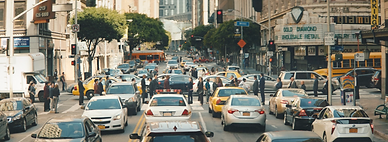
We pan up from our firefighter to the nighttime sky. The night sky dissolves into a daytime sky. We pan down, revealing our spokeswoman standing in the city during the day with a busy intersection behind her. She says:
“Because 5G reduces latency so dramatically, it can also transform the way city planners manage congestion and growth.”
In this frame, we slow the world down. The city goes quiet. Our graphics begin to appear, growing out of every vehicle, tracking with their every move to show how smart sensors and cameras analyze traffic conditions with vehicle location, speed, and volume. While this is happening, our spokesperson continues to talk at normal speed:
“5G-enabled traffic systems can interconnect HD cameras, sensors in roads and…”
Cut to a wider, higher-angle shot of this intersection while our graphics continue to grow and expand. The VO continues:
“…artificial intelligence to capture and analyze massive amounts of data in milliseconds.”
From this higher angle, looking down on the city street, we ramp back to regular speed. The camera pans over, revealing our spokeswoman, now standing on the top of a building that overlooks the city! As she walks and talks, we get a 360-degree view of the cityscape and its surrounding neighborhoods — which will enhance the word “communities” in her next line:
“Transportation managers and planners can use these insights to keep traffic moving, improve driver safety and make communities more livable.”
The camera pans up to the sky.



SCENE 3: EDUCATION USE CASE
We pan down from the sky, revealing our spokeswoman now standing in a beautiful nature setting. She says to camera:
“In the era of 5G, education can get more visual, powerful and real.”
We pan over to find a TEACHER pointing out things in nature to some young STUDENTS, who all have tablets.
“Greater bandwidth brings new learning possibilities in virtual and augmented reality.”
Graphics begin to grow out of their tablets. Time slows down, the sounds of nature soften, and our graphic overlays appear, showing viewers what the kids are seeing — names of trees and plants, species of birds and butterflies, bees pollinating flowers, etc.
We cut to various close-ups on our hero kids’ faces, showing the wonder and awe of their discoveries, all thanks to the power of Verizon’s 5G. This is a great opportunity for us to highlight some humanity with the technology. We hear:
“Students can interact with teachers and peers in new ways.”
We cut to an over-the-shoulder shot on a kid’s tablet to see what she is learning.
“And the classroom can come to the students, opening up a whole new world of learning.”
We pan over to our spokeswoman and track backwards with her while she speaks to camera:
“When you’re building the future for citizens and communities, you need a network built right. So be ready with the Verizon 5G Ultra-Wideband network.”
We pan into the trees, into nature, and hold this image for our titles and Logo.
Title card: Are you ready?
Logo: Verizon Logo


OPENING SCENE: CITY
In this film, our spokeswoman takes us from city street to high above the city to a fiber optics installation crew and into a high-tech manufacturing plant. Our aim with this film is to show how Verizon’s 5G operates better than its competitors, and for one simple reason — because it was built correctly.
Let’s open with a shot of the city traffic. We pan over to reveal our spokeswoman walking toward us. The camera tracks backwards with her as she speaks to us:
“Time matters in business. And today, seconds can be more important than quarters. This demand requires a network that pushes real-time capability. That’s why at Verizon, we’re building just that — the 5G Ultra Wideband Network. And we’re building it right.”
SCENE 1: MILLIMETER SPECTRUM
We pan away from our spokeswoman to see pedestrians crossing the median. Time slows to a near-frozen moment. The sound fades and our graphics grow all around the people. Our spokeswoman appears in real time, walking between the near-frozen people in the intersection. She speaks to camera, mid-walk:
“Building it right begins with a valuable resource you’ll never see or feel, yet is essential to being real-time ready.”
Cut to a guy standing on the street corner looking at his phone. Time is still suspended. Our graphic overlay animates out of his phone. His stats appear, highlighting the phone’s 5G capabilities. We hear our spokeswoman’s VO:
“It’s called millimeter wave spectrum, and it’s the foundation of our network. With it, we’re able to scale to billions of connections and support the massive and near-instant data throughput your business requires.”
Wider framing reveals how our graphic overlays are connecting everything – from vehicles to traffic lights to cameras, sensors, devices, and surrounding buildings. The expanding graphics create a web-like overlay.


SCENE 2: SMALL CELL DEPLOYMENT
From a low angle looking up, we see the expanding web-like overlay, growing larger and larger, enhancing the word “robust” in the following line as our spokeswoman steps up in real-time, looks into camera and says:
“Building it right means creating a robust 5G infrastructure—one you can trust to deliver just about anything your business demands.”
She looks up. As she does, the camera floats upward. We pass through the numerous layers of graphic overlays. The camera suddenly takes off, rising high above the city. We’re now in our overhead shot looking straight down. The graphic overlays begin to pop up, highlighting the various small-cell sites on the tops of buildings. These graphics appear on different planes, adding depth to this striking image. We hear:
“That’s why we’re building 5G Ultra Wideband with a dense network of small-cell sites.”
SCENE 3: FIBER
From high up looking down, we pan up to the sky, then pan back down to see we’re now on the ground with a CABLE CREW working with fiber optic cables. We cut into tight, slow-motion imagery of our fiber crew at work as we hear:
“Building it right means making the best connections possible where they’re needed.”
We widen out to reveal our spokeswoman and track backwards with her as she crosses the street. We can still see the fiber crew working behind her. She talks to camera:
“So for 5G, we’re expanding on our already massive fiber backhaul with more than a billion dollars in new fiber-optic cable…”
To add emphasis here, she stops close to camera and says:
“enough to wrap the earth 500 times.”
She breezes by us and we spin around, trying to catch up. She walks toward a building, pulls a door open, and enters. The inside is dark, and we use this negative space as a transition into the next scene.


SCENE 4: EDGE COMPUTING
She comes through the doors of a high-tech manufacturing plant, walking and talking to camera:
“And building it right means planning a network architecture that supports future possibilities.”
We’ll find an architecturally interesting, modern, high-tech plant with visually appealing lighting fixtures and trick it out with some of our own practical sources. Our lens focuses on a conveyer belt. Above the belt, an HD camera analyzes the finer details of the parts this plant makes, looking for the tiniest errors and anomalies. Just then, a red light on the camera illuminates, indicating that it has pinpointed a microscopic imperfection or flaw in one of the devices — an invaluable tool that greatly improves a company’s quality control.
We slow the scene down. Our graphics overlays appear, highlighting the error detected, and verifying the technology. We hear her VO:
“That’s why we’re bringing computing right to the edge of the network. The resulting ultra-low latency will open up a world of possibilities — like artificial intelligence that could realize significantly more uptime for business.”
The camera drifts downward, past the conveyer belt.
Back on the city sidewalk, we drift down off a street sign to see our spokeswoman and track backwards as she speaks to camera.
“Even when measured in milliseconds, time is our most valuable resource. That’s why we’re building our 5G Ultra Wideband network right, to keep your business ready. Starting now.”
She moves off camera and we hold on the image of the city for titles and logo.
Title card: Are you ready?
Logo: Verizon Business Ready logo


I am so excited to shoot these films in Chile. I know firsthand that it’s a truly remarkable place, one that makes it easy to go from city sidewalk to nature preserve, from modern skyscraper to a near-future industrial manufacturing plant without breaking a sweat.
It’s exactly the place we need in order to bring a sense of global scale to this film. Instead of restricting our ideas, Chile will empower us to design the most interesting vignettes we can think of, and I look forward to figuring out with you guys how best to take advantage of everything Santiago has to offer.
As for our graphic overlays, something to consider when we scout is to keep the environments and backgrounds around our characters simple, clean, and tonally consistent. That way, our design and graphic overlays won’t get lost or muddled in a scene. This will be a major consideration in our planning and the design of our images.


WARDROBE
STYLE

COLOR

Since we are creating a near-future look, the art direction and wardrobe need to be relatable to viewers. In other words, grounded in the present but pushed a slightly into the near-future. So, a bit more modern, a bit more sleek, yet still realistic and recognizable.
Wardrobe will be fitted and tasteful. For creative reasons, I prefer to dress most talent, including extras, towards the tonality of each environment, while allowing our hero characters to stand out with accessories or with specific pieces, such as a sweater, tie, jacket, etc.
As with the wardrobe, I like to let the locations motivate much of the propping, and then gear any additional art direction towards that singular tone, going warmer or cooler or more neutral based on what the script calls for and the environment demonstrates.


RETAIL STORE
For our near-future retail store, we will look to a film like Ex-Machina for its use practical lighting techniques and the simple, clean design of its interiors.


CLASSIC



The cinematography will be natural and realistic, yet still premium and clean. The unifying look and feel across the campaign will be authentic, warm, inviting. It’s reality— only slightly better — a tad heightened and a touch more beautiful.
I recommend shooting in 4K or higher to give us a high resolution for our graphic overlays, rotoscoping, and comping of our spokeswoman into our slow-motion scenes. The higher resolution will allow you to push-in or pull-out on certain scenes if you want to add camera movement in post.
For our slow-motion images, to slow some of our scenes down to a near frozen moment, we will need the ability to shoot 500fps or more. Since not all cameras can do both high-resolution and high-speed, we will look to utilize a camera like the new Sony Venice, or a larger format camera, like the Arri65.
The graphics are an exciting component to these films. I love the interaction between the reality, the near future technology, and the graphic overlays. In preparation for our shoot, we’ll develop shooting and design boards in tandem with our graphics and VFX. That way, we will make certain all our elements mesh seamlessly with our cinematography.
NATURAL
REAL


click below to know more about
Paul Theodoroff


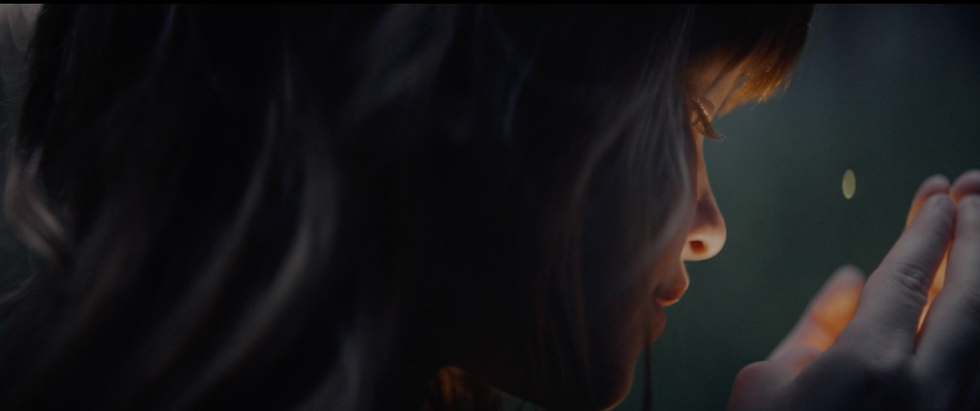


As I was writing the treatment, the music I kept hearing in my head had a cool, modern instrumental design. Something atmospheric, along the lines of Max Richter’s “Three Worlds”, that will enhance the mood and subtly support visuals rather than overwhelm them. An original composition would be ideal, something new and fresh, that maybe even integrate some subtle environmental sounds relevant to each scenario.
As for sound design, allowing the natural sounds of our environments to come through will be a nice touch for these films. It’s a technique that will really bring out the humanity in a scene and paint a fuller picture of our characters worlds.
It would also be cool to create a sound unique to the graphics, something like a gentle electronic “sting” that comes up as the graphics appear on screen. It’s something we can discuss and build upon as we move forward.
SOME WORDS FROM OUR MUSIC AND SOUND PARTNERS, ANIMAL MUSIC
AUDIO TECHNIQUE
Blurring the lines between sound design and music is always a challenge but when done well, it can make for a very interesting audio experience. Finding the right balance between musical score and sound design elements can help make the music and sound design feel more internal in the storytelling of the commercial by creating a sort of choreography between the music and the sound effects where neither takes a leading role. Here are some examples we’ve done in the past where the music and she sfx work together in tone and rhythm to create one overall audio experience.

TONE AND VIBE
We felt attracted to the idea of finding an overall vibe that paradoxically feels both modern and even a bit “techy” while painting a very much organic and real atmosphere. Music that feels futuristic while very much remaining grounded on Earth rather than going off completely into space.To help inspire some idea of the mood we are trying to capture, this playlist travels across the sonic spectrum we’re imagining for these spots. Our primary focus was mood & atmosphere but we also felt a good sense of pace and an overall feeling of aspiration was important to incorporate into our song selections.

MUSIC
click below to hear a mood playlist
by Animal Music


It’s a joy for me to consider all the creative possibilities that will realize the amazing potential of these films. I know viewers everywhere will recognize Verizon’s 5G as the one to trust, especially given the company’s effort in developing this forward-thinking technology. There is an extremely compassionate, noble effort behind the work that Verizon does, and together we can create films that are informative, uplifting and inspiring.
Thank you for inviting me to share my thoughts on this very exciting project. I look forward to speaking with you again, and to collaborate with you to bring these wonderful scripts to life.


DETAILS

Thanks for the opportunity!
-- JB


